Japan, Worked Out.
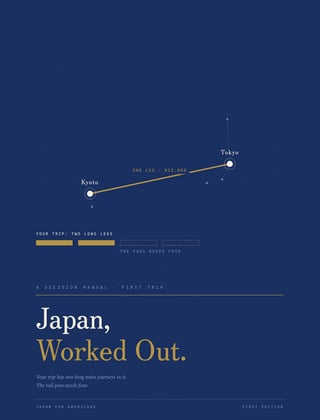
Most first trips to Japan are two cities, one Shinkansen leg and a fortnight of day trips — which means a lot of the advice you have read, starting with "buy the rail pass", is priced for a trip you are not taking.
The rail-pass call alone is worth about ¥22,000 — roughly $140 — on the two-city trip most first-timers actually take. It is one of nine in the book.
The decisions a day trip is knotted to
The free articles below answer each step on their own. The decision manual is what connects them — the exception at each join, and what to do once it applies to you.
- 1
- 2Whether the JR Pass pays for itself
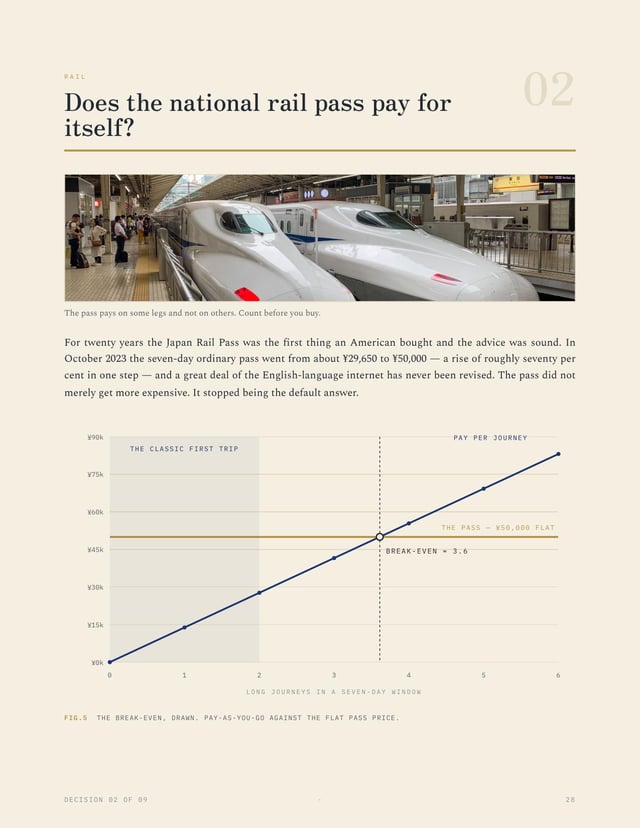
Whether the pass pays is not a fact about the pass — it is a fact about how many cities you chose, usually decided after buying it.
- 3Which transit card to load before you land
Which card loads decides whether you need a physical one, which decides whether you need cash on arrival — a separate problem the pass decision does not solve.
- Does the national rail pass pay for itself — and what does it cost you if it doesn’t?
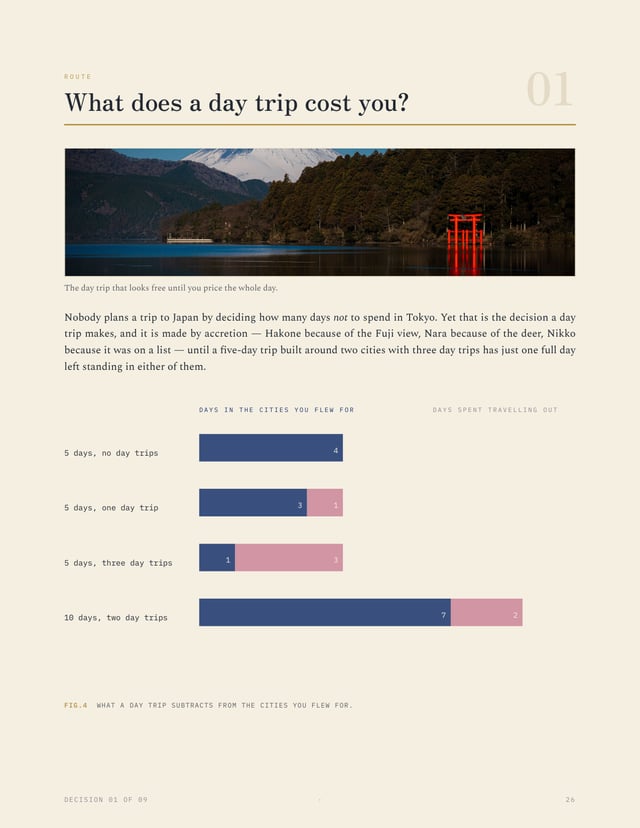
- What does a day trip actually cost, in days you wanted somewhere else?
- Which card will load a Suica on an American phone?
- When should you come, and what does that date lock in six months early?
Each one is answered with the arithmetic printed on the page, so you can disagree with the call and still come out ahead.
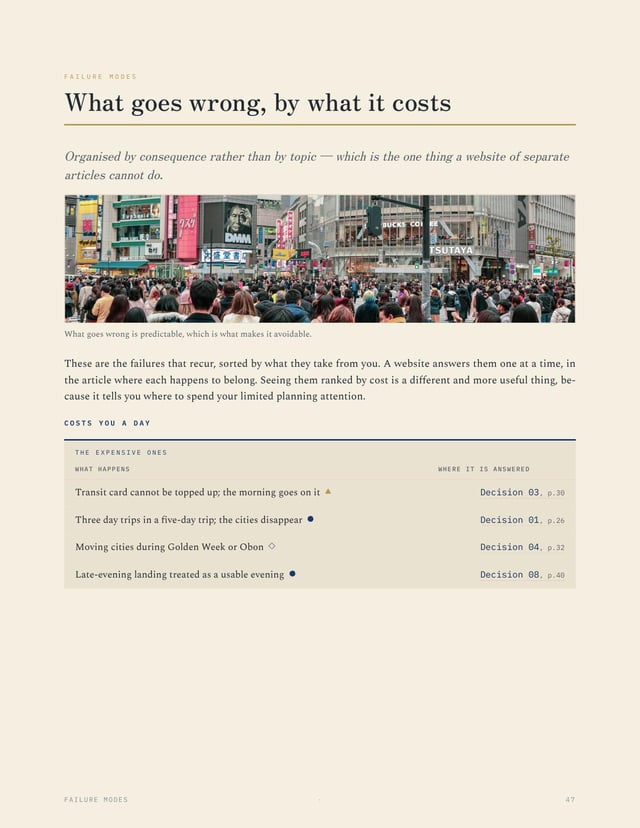
Where the money and the days actually go
Almost nothing about Japan is hard. What it is, is over-decided — a dozen choices that each look small and are quietly wired to each other. The three that cost the most look like this.
You buy the rail pass first, because everyone says to, and then bend the route to justify the ¥50,000 (about $310) — a day trip added because it’s free, a city inserted because the train is covered, and a fortnight that was going to be two calm bases turning into five hotels and a lot of luggage on platforms.
You stack three day trips into a five-day trip, and end up with barely two days standing in the cities you flew for. And you land at Haneda with a transit card your bank won’t load, which you discover at a ticket gate at nine in the morning with a queue behind you.
None of those is exotic. All three are avoidable in the order you make the decisions, which is what this book is.
Every claim carries its provenance
Every statement is marked for how much weight it still bears: established, official, surveyed with a date, or volatile. Anything that couldn’t carry a mark was cut rather than softened — travel writing rarely separates a fact that has held for forty years from a price checked once in spring, and you are entitled to know which one you are being handed.
See the reasoning behind a specific call →
What it refuses to do
It will not name hotels — we haven’t slept in them, and an assessment of a room we haven’t been in is a booking-site listing with a confident voice on top. It will not name restaurants, because a list is wrong within a season while the rule that generated it still works in five years. And it prints no live prices, because a price set in a book stops being true quietly.
So what happens when the numbers move?
They move on the Field Sheet, not in the book. You get two files: the book, which argues the decisions and is built to stay true for about two years, and a dated one-page Field Sheet carrying every fare, deposit and ceiling those arguments run on. It is reissued every quarter and yours to re-download free for as long as you own the decision manual — the link is printed inside the sheet itself.
The free articles on this site answer the questions, and they stay free. The decision manual is where they are joined into the sequence — because the expensive mistakes are never made inside one question. They are made in the connections between them.
What arrives, and when
Both files are PDFs, and they arrive the moment the payment clears — nothing is posted, nothing is drip-fed, there is no account to make. Read them on a phone or print them; the book is laid out for paper at 50 pages.
Because it is delivered whole and at once, a sale is final. That is why three real pages are shown below before you spend anything — not a cover, not a contents list, actual spreads with the arithmetic on them. Read them first.
See inside